
Did you know that an average Indian household throws away nearly 50 kg of organic waste every single month? From the morning tea leaves to the evening’s vegetable peels, our kitchens are bustling factories of organic matter that usually end up in a plastic bag, destined for a stinking landfill. But what if you could turn that “kachra” into “kaala sona” (black gold) right in your balcony or utility area? With the rise of urban gardening and the push for a Swachh Bharat, more and more Indians are switching to composter machines to manage their waste responsibly. This isn’t just a trend; it’s a lifestyle shift toward self-sufficiency and environmental pride. In this blog, we’ll break down how these modern marvels work, why every Indian home needs one, and the different types of machines that make sustainability look easy.
1. The Science Inside: How Composter Machines Work
At its core, a composter machine is a high-tech version of a forest floor. In nature, organic matter decomposes over months. However, in an urban apartment, you don’t have months—and you certainly don’t want the smell.
These machines use Aerobic Digestion to accelerate the process. Most modern systems, like the ones designed by Smartenviro Systems Private Ltd, use a combination of:
- Shredding: Breaking down large chunks of food into smaller pieces to increase the surface area.
- Heat Regulation: Maintaining a temperature between $50^\circ\text{C}$ and $60^\circ\text{C}$ to kill pathogens and speed up microbial activity.
- Aeration: Regularly mixing the waste to ensure oxygen reaches the bacteria (the “good guys”).
- Microbial Culture: Special inoculums or “compost starters” that jumpstart the breakdown.
By controlling these variables, an organic waste converter can transform food scraps into stable, nutrient-rich compost in as little as 24 hours to a few days, compared to the 3-6 months required by traditional pits.
2. Why Every Indian Household Needs a Composting Machine
According to a 2024 report by Nature Climate Change, using a food waste composter can reduce methane emissions by up to 80% compared to landfilling that same waste. Methane is a greenhouse gas far more potent than $CO_2$, and our overflowing landfills are a major source of it.
- Stop the Smell: Traditional dustbins leak “leachate” (the smelly black liquid). A closed composting machine keeps your kitchen and society premises smelling fresh.
- Financial Savings: For housing societies, on-site processing reduces municipal waste collection fees. Individually, you save on buying expensive organic fertilizers for your plants.
- Legal Compliance: Municipalities across India are now making it mandatory for “Bulk Waste Generators” to process their own wet waste. An organic waste compost machine ensures you stay on the right side of the law.
- Premium Gardening: The output is 100% natural manure, perfect for those growing organic tomatoes, chilies, or herbs in their kitchen garden.
3. Types of Composter Machines Available in India
Not all homes or societies have the same needs. Here is a quick comparison:
Type | Best For | Level of Automation |
Manual Tumblers | Small homes with balconies | Manual (you turn the handle) |
Semi-Automatic OWC | Small apartments/cafes | Partial (automatic mixing/heating) |
Fully Automatic (Electric) | Large families & societies | High (Plug-and-play) |
Smart Xpress Series | Large societies/Industries | Ultra-High (Smartenviro exclusive) |
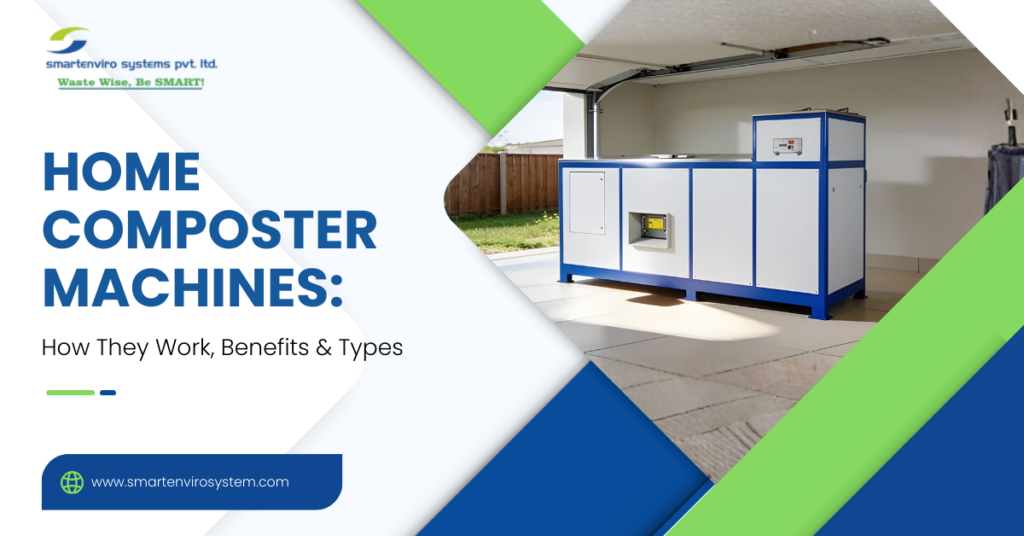
For large-scale residential complexes, an organic waste composter machine needs to be heavy-duty. Smartenviro Systems Private Ltd offers the Smart Xpress series, which is fully automatic and can handle up to 1250 kg of waste per day. It’s designed specifically for the high-moisture, spicy nature of Indian food waste, ensuring the machine doesn’t clog or fail.
4. Promoting Sustainability with Smartenviro Systems Private Ltd
When you invest in a food waste composter, you aren’t just buying a machine; you’re buying a service. This is where Smartenviro Systems Private Ltd stands apart. With over 10 years of experience and more than 900 satisfied clients, they understand the Indian waste landscape like no one else.
Their organic waste converter models, such as the Smart Drum Composter, provide a complete system in a single unit—shredding, mixing, and curing all happen seamlessly. Because they use high-grade materials and Siemens-equivalent electrical components, these machines are built to last in the humid and varied Indian climate. Indirectly, by choosing a company that treats over 170 tons of waste daily, you are contributing to a massive national reduction in landfill dependency.
5. 3 Tips to Get the Most Out of Your Composter
- Balance Your Browns and Greens: Even in an organic waste compost machine, a mix of “greens” (kitchen scraps) and “browns” (dry leaves, sawdust, or cardboard) creates better quality manure.
- Avoid Non-Compostables: Ensure no plastic, metal, or dairy (unless the machine specifically allows it) enters the chamber.
- Regular Maintenance: Just like your washing machine, a composting machine needs a quick check-up. Smartenviro provides excellent AMC (Annual Maintenance Contracts) to keep your system running 24/7.
Leading the Way to a Zero-Waste Future
Moving toward a zero-waste lifestyle doesn’t mean you have to be a scientist or live on a farm. Modern composter machines bring the efficiency of industrial technology right to your doorstep. Whether you are a solo eco-warrior in a 2BHK or a committee member of a 500-flat township, there is a solution that fits your space and budget.
By taking charge of your organic waste, you are literally giving life back to the soil. It’s a small step for a household but a giant leap for the environment.
Ready to transform your society’s waste management?
Would you like me to help you draft a proposal for your Housing Society Committee regarding the installation of a Smartenviro Composter.