
What happens to the 100 kg of food and wet waste your facility generates today after the collection vehicle takes it away? For many hotels, housing societies, malls, hospitals, campuses and industrial canteens in India, that question is becoming increasingly important.
India’s Solid Waste Management Rules, 2026 have changed the conversation from simply “disposing of waste” to taking greater responsibility for what happens to it. The rules strengthen source segregation and accountability for bulk waste generators, making solutions such as a composter machine, organic waste converter and composting machine increasingly relevant for organisations that generate significant quantities of biodegradable waste. This article explains what’s changing, why on-site processing matters and what bulk waste generators should consider before choosing a solution.
What Changed for Bulk Waste Generators in 2026?
India’s waste-management framework has become more specific.
The Solid Waste Management Rules, 2026, notified by the Ministry of Environment, Forest and Climate Change and effective from 1 April 2026, mandate four-stream segregation at source: wet waste, dry waste, sanitary waste and special care waste.
The rules define bulk waste generators using thresholds including a floor area of 20,000 square metres or more, water consumption of 40,000 liters per day or more, or solid waste generation of 100 kg per day or more. The framework also introduces Extended Bulk Waste Generator Responsibility (EBWGR). Bulk generators are required to process wet waste on-site as far as possible or follow the prescribed EBWGR mechanism where on-site processing is not feasible.
The scale is significant. According to the Government of India, bulk waste generators account for nearly 30% of India’s total solid waste generation.
That makes decentralised waste processing much more than a sustainability talking point.
Why Sending All Your Wet Waste Away Is No Longer the Best Approach
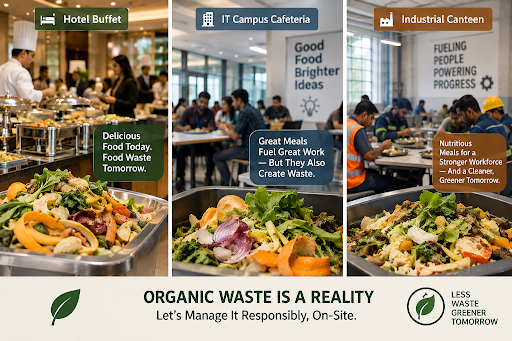
Consider a large hotel buffet, an IT campus cafeteria or an industrial canteen. Vegetable peels, leftover food and kitchen waste are generated every day.
When wet waste is mixed with other waste, stored for long periods and transported elsewhere, organisations can face problems such as odour, hygiene concerns and greater dependence on collection and transportation.
On-site processing changes the model.
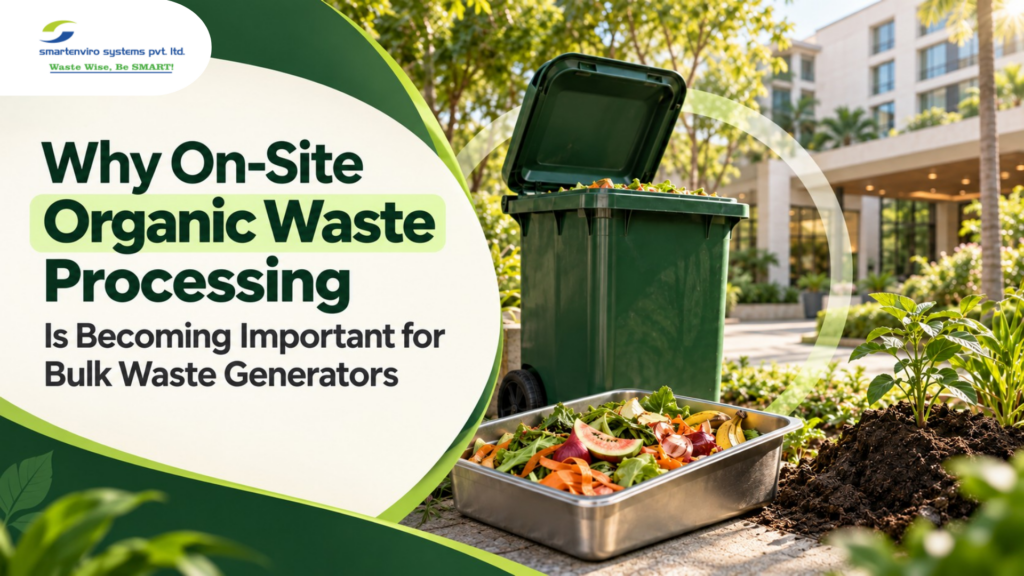
Instead of viewing food waste only as something that needs to leave the premises, businesses can segregate biodegradable waste and process it closer to where it is generated.
A properly selected organic waste converter can become part of this decentralised approach, particularly for facilities that produce predictable quantities of food and biodegradable waste every day.
How Does On-Site Organic Waste Processing Work?
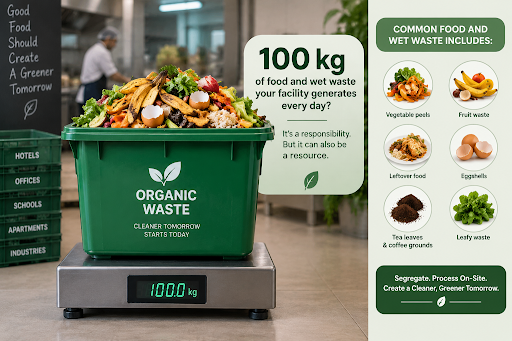
The exact process depends on the technology being used.
Generally, segregated biodegradable waste is collected and contaminants such as plastic, glass and metal are removed. The organic material can then be shredded, mixed and processed under controlled composting conditions.
This is where choosing the right composting machine becomes important.
Smart Enviro Systems Private Ltd offers several technologies rather than relying on a single machine for every application. Its current portfolio includes the Smart Xpress Composter, Smart Drum Composter, Smart Batch Composter and Covered Aerated Static Pile Composting system. The company also offers Smart Squeezer solutions for dewatering organic waste and sludge.
This matters because the waste generated by a 200-flat residential society is not necessarily the same as the waste generated by a large hotel, mall or industrial facility.
A Composter Machine Can Reduce Dependence on Waste Transportation
One practical advantage of on-site processing is that it can reduce the amount of wet waste that needs to be transported away for treatment.
For large facilities generating waste every day, collection is not merely a housekeeping task. It requires storage, manpower, vendor coordination and timely pickup.
A composter machine allows biodegradable waste to enter a defined treatment process within the facility itself.
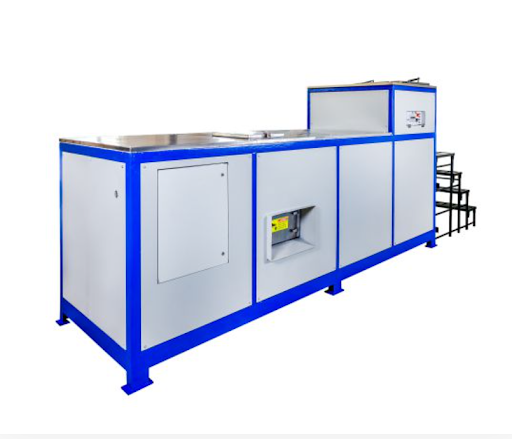
Smart Enviro Systems says its composting solutions cover applications ranging from relatively small facilities to large-scale waste generators. Its Smart Xpress range, for example, is available in capacities from 30 kg/day to 1,500 kg/day and uses an automatic aerobic thermophilic composting process.
The company’s broader portfolio addresses significantly larger capacities as well, making capacity selection an important part of planning rather than simply purchasing the largest machine available.
Organic Waste Can Become a Resource Instead of a Daily Disposal Problem
The circular-economy principle behind the 2026 rules is important: waste should increasingly be recovered, processed and returned to productive use rather than simply moved from one location to another.
Composting follows that principle naturally.
An organic waste converter can help transform biodegradable waste into compost that can potentially be used for landscaping, gardens and other suitable applications.
For hotels, resorts, residential complexes, institutions and corporate campuses with landscaped areas, this creates a more meaningful waste-management cycle.
Waste from yesterday’s kitchen can eventually support tomorrow’s greenery instead of simply adding another load to the waste collection vehicle.
Not Every Composting Machine Is Right for Every Facility
Buying a composting machine based purely on price or maximum capacity is a mistake.
Before choosing a system, facility managers should evaluate the type of organic waste generated, daily and peak waste volumes, moisture content, available installation space, manpower, power requirements, expected composting process and maintenance needs.
Smart Enviro Systems’ different technologies address different operating conditions. Smart Xpress is an in-vessel mechanical composting system with an inbuilt shredder across its specified range. Smart Drum provides an integrated composting approach, while Smart Batch incorporates shredding and mixing. Covered aerated static pile composting provides another option for larger-scale applications.
The question, therefore, should not be, “Which is the best machine?”
It should be, “Which system matches the waste our facility actually generates?”
Technology Alone Will Not Solve a Poor Waste-Management Process
Installing an organic waste converter does not automatically create an effective waste-management system.
If food waste arrives mixed with plastic packaging, bottles and other contaminants, even a capable machine will be operating within a poor process. Source segregation, trained operators and regular maintenance are equally important.
This is where Smart Enviro Systems takes a broader approach. Along with equipment, the company provides operation and maintenance support, integrated solid waste management covering collection and segregation, wet-waste treatment, dry-waste disposal through authorised channels, liaison support with local authorities, and manpower or supervision for relevant waste-management operations.
For a bulk waste generator, that distinction matters. The objective is not simply to own a composter machine; it is to build a waste-management process that continues to work after installation.
Why Smart Enviro Systems Fits the On-Site Processing Approach
Smart Enviro Systems Private Ltd has been working in organic waste management for more than a decade. According to the company, its installed systems collectively treat around 170 tonnes of waste every day, and it has served more than 900 clients.
Its solutions are used across residential complexes, hotels, resorts, malls with food courts and industrial canteens, precisely the kinds of properties where regular organic waste generation can make on-site processing relevant.
The company also assesses customer operations and composting requirements before recommending a suitable solution, rather than positioning one technology for every site.
That approach becomes increasingly valuable as compliance, segregation, operational efficiency and measurable waste processing become more closely connected.
From Waste Disposal to Waste Responsibility
For years, many facilities treated waste management as a simple process: collect it, hand it over, and move on.
The Solid Waste Management Rules, 2026 push bulk waste generators toward greater accountability. The government’s framework emphasizes four-stream segregation, environmentally sound processing, extended bulk waste generator responsibility, and digital monitoring of waste-management activities.
For organisations generating significant quantities of biodegradable waste, this makes on-site processing worth serious consideration.
A correctly sized composting machine or organic waste converter, supported by proper segregation and trained operation, can help organisations build a more systematic approach to wet-waste management.
The shift is ultimately bigger than installing equipment. It is about changing the question from “Who will take our waste away?” to “How responsibly can we manage the waste we generate?”
For India’s bulk waste generators, that is rapidly becoming the more important question.