
What if the food waste generated in your apartment, hotel, office canteen or factory today did not have to leave the premises as garbage tomorrow?
That is the question more Indian organisations are now asking as waste management moves towards source segregation and on-site processing. For a facility manager, housing society committee or business owner, sending wet waste outside every day can mean transportation costs, odour concerns and dependence on external collection systems. A composter machine offers a different approach by processing suitable organic waste closer to where it is generated.
In this guide, we will explain how a composter machine works, what happens to organic waste inside the system, the role of segregation and maintenance, and how to choose the right technology for your facility. We will also look at why solutions from Smartenviro Systems Private Ltd are designed around different waste volumes and operating requirements. So, where does the process actually begin?
What Is a Composter Machine?
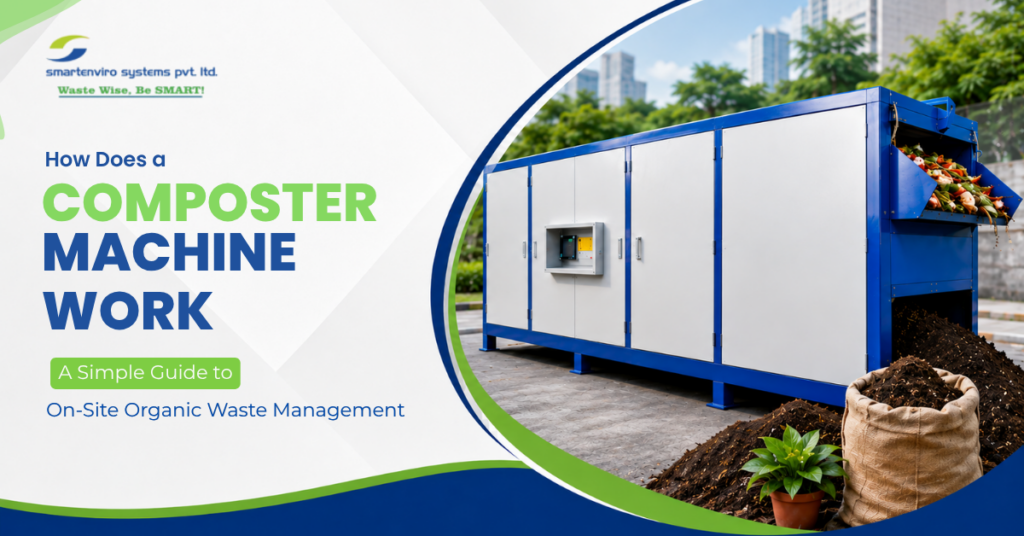
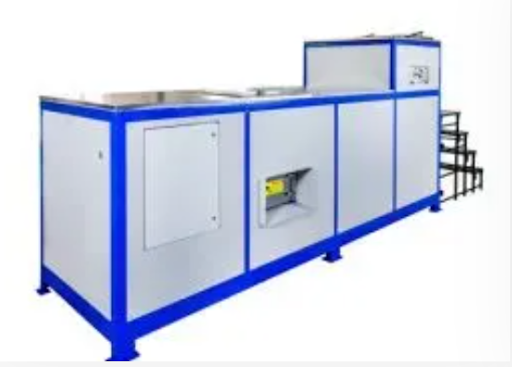
A composter machine is a system designed to process biodegradable organic waste such as food waste and other suitable wet waste under controlled conditions.
You may also hear terms such as organic waste converter or composting machine. While the terminology can vary, the objective is similar: to reduce and process organic waste in a more controlled way instead of sending all of it to a landfill or external disposal site.
Smartenviro Systems Private Ltd designs and supplies decentralised organic waste management solutions and offers multiple composting technologies. Its product range includes the Smart Xpress Composter, Smart Batch Composter, Smart Drum Composter and Covered Aerated Static Pile Composter, allowing facilities to select solutions according to their waste volume and operational requirements.
The important point for first-time users is that a machine does not magically turn mixed garbage into useful compost. The quality of the input material and the way the system is operated matter significantly.
Step 1: Segregating Organic Waste
The composting process starts before the waste enters the machine.
Organic waste should be separated from dry waste, plastic, glass, metal and other unsuitable materials. For example, food scraps from a hotel kitchen or residential complex should ideally be collected separately from packaging and other non-biodegradable waste.
This is one of the biggest practical challenges in on-site waste management.
If plastic wrappers, cutlery or other contaminants enter the system, they can affect the process and increase the work required from operators. Good segregation therefore improves both the quality of the output and the efficiency of the composting machine.
This focus on decentralised processing is becoming increasingly relevant in India. Recent implementation and enforcement discussions around bulk waste generators have placed greater attention on segregation and on-site processing of organic waste, particularly for large institutions, hotels, apartment complexes and similar facilities.
In simple terms, better input generally leads to a better composting process.
Step 2: Preparing the Waste for Processing
Once segregated, the organic waste is prepared for treatment.
Depending on the type of system and waste stream, this may involve reducing the size of the waste, removing excess unwanted material and mixing the waste with a suitable bulking or conditioning material.
Why is this necessary?
Food waste can have a high moisture content. A successful composting process requires a suitable balance between moisture, air and organic material. If the material is excessively wet or compacted, airflow can be affected.
Different machines handle this requirement differently. That is why an organic waste converter should be selected based not only on the total quantity of waste generated but also on the type of waste.
A hotel kitchen, for example, may generate a very different waste stream from a residential complex or a food-processing facility.
Smartenviro Systems provides site assessment and consultancy services to understand an operation’s composting requirements and recommend an appropriate solution. The company also provides integrated waste management and operation and maintenance support.
Step 3: Controlled Mixing and Aeration
This is where the actual biological process becomes important.
Organic material naturally decomposes because microorganisms break it down. A composter machine helps create and maintain controlled conditions that support this process.
Depending on the technology used, the system may provide controlled aeration, mixing or turning of the organic material. These actions help improve contact between microorganisms, moisture and oxygen.
You can think of it like this: the machine helps create a more managed environment for decomposition rather than simply leaving a pile of food waste to break down on its own.
This controlled approach can help facilities manage waste more efficiently in limited spaces.
Smartenviro Systems states that it offers three different composting technologies in India, including Smart Xpress, Smart Batch, Smart Drum and Covered Aerated Static Pile systems. This range is useful because the same technology is not necessarily suitable for every organisation.
Step 4: Moisture, Air and Temperature Are Managed
A composting process depends on several conditions working together.
The material needs appropriate moisture.
It needs sufficient airflow.
And the biological activity inside the organic material can generate heat as microorganisms work.
If these conditions are poorly managed, the process can slow down or create operational issues such as odour.
This is one reason why simply buying a composting machine is not enough. The machine must be properly operated and maintained.
For facilities with large daily waste volumes, automation can help create a more consistent process. However, even an automated organic waste converter depends on proper waste segregation and appropriate loading practices.
Smartenviro Systems supports its machines with operation and maintenance services and can also provide manpower and supervision as part of its waste management solutions.
That operational support can be particularly valuable for organisations installing an on-site system for the first time.
Step 5: The Waste Is Processed Into a More Stable Material
The best composter machine is not necessarily the biggest or most automated one.
The right choice depends on:
Daily waste quantity: How many kilograms of organic waste are generated each day?
Type of waste: Is it mainly kitchen waste, food waste or another organic waste stream?
Available space: How much area is available for installation and operation?
Power requirements: What electrical infrastructure is available?
Staff availability: Who will operate and monitor the system?
Future waste generation: Is the facility likely to expand?
Smartenviro Systems’ product range is designed across different capacities and technologies. The company’s website highlights installations ranging from smaller systems to large-scale solutions, while also reporting more than 900 clients and approximately 170 tonnes of waste treated daily across its operations.
Why Technology and Service Support Matter
For a housing society, hotel, industry or institutional campus, buying an organic waste converter is a long-term operational decision.
The machine needs to match the waste stream.
The site needs to be properly assessed.
The operators need to understand the process.
And maintenance support should be available.
Smartenviro Systems Private Ltd combines equipment supply with consultancy, installation, commissioning and operation and maintenance services. Its approach includes assessing the customer’s composting requirements before recommending a suitable solution, rather than treating every waste generator as if it has the same needs.
Final Thoughts
A composter machine works by bringing together the right organic waste, controlled processing conditions and appropriate operational practices to manage biodegradable waste on-site.
The basic process is straightforward: segregate the waste, prepare it properly, process it under controlled conditions and manage the output responsibly.
But successful composting depends on more than machinery. Proper segregation, the right technology, trained operation and ongoing maintenance all play an important role.
For Indian apartments, hotels, industries, institutions and commercial facilities looking to take greater responsibility for their organic waste, solutions from Smartenviro Systems Private Ltd demonstrate how decentralised waste processing can be approached as a complete system rather than simply a machine purchase.
The real question is not just, “How does a composting machine work?”
It is also, “Which process and technology will work best for the waste generated at my facility?”